Are you looking for a quick, witty and amusing history video series to supplement your studies, or to refresh your own memory of world history?
Well, here's just the series for you!
"Mr Green will this be on the test?"
"Yeah, about the test...the test will measure whether you are an informed, engaged, and productive citizen of the world; and it will take place in schools, and bars, and hospitals, and in dorm rooms, and in places of worship. You will be tested on first dates, in job interviews, while watching football and while scrolling through your twitter feed. The test will judge your ability to think about things other than celebrity marriages, whether you'll be easily persuaded by empty policital rhetoric and whether you'll be able to place your life in your community in a broader context. The test will last your entire life and it will be comprised of the millions of decisions that when taken together make your life yours. And everything....everything, will be on it"
This video has some very entertaining humor and gets right to the point. It's a quick survey of the concept of the rise of farming. Great for middle schoolers or as a refresher course for anyone!
Showing posts with label resources. Show all posts
Showing posts with label resources. Show all posts
Friday, September 6, 2013


Tuesday, September 4, 2012
Assignment Deadlines - Using Google Calendar
Yet another awesome way to use the power of Google in your home school is to use their Calendar feature to set up assignment deadlines.
To find your Google Calendar, just log into Google (surely you've got a Google account by now...) and find the calendar: Link www.google.com/calendar/
Once you're in the Calendar click on the date you wish to schedule something. Let's say that a Rough Draft of Essay 1 is due on September 20th.


Using Google for Writing Assignments
Using Google Docs in Your Home School
To find your Google Calendar, just log into Google (surely you've got a Google account by now...) and find the calendar: Link www.google.com/calendar/
Once you're in the Calendar click on the date you wish to schedule something. Let's say that a Rough Draft of Essay 1 is due on September 20th.
- Simply click on the date directly on the calendar.
- A window will pop up.

- Type in "what" the event is: Essay 1 rough draft due, then click edit event>>.

From here you can do all sorts of edits, like:
- Change the time or date.
- Make the event a "repeating event" (handy for reminder about weekly tests....or putting out the garbage!)
- There's a description box to add the details of the "assignment."
- You can change the event color.
- And to the right you can "Add guests" well, our "guests" are actually the student who needs to complete the assignment!
And finally, and the beauty of this, is that you can also add Reminders. You can set email reminders (or "pop-up" reminders...which I only find handy for things like "turn off the computer now." otherwise you need to be logged in to get them - unless your google account is synched to your iPod...but that's another post.)
Now that you've set up the assignment and added the guest, and put in the reminders, you can sit back and let Google do the reminding about completing the rough draft of Essay 1 and spend your time naggin- er, - prompting about more important things! All you need to be sure of is that your student checks their email!
What else could a Google Calendar do to make your life easier?
Using Google Docs in Your Home School
Sunday, September 2, 2012
Using Google for Writing Assignments
My last post mentioned creating GoogleDocs to share with your home school students.
Why not do it in reverse? This is a great tool for teenagers, especially. But it can be useful and fun for some younger students.
Last year my then-7th grader used GoogleDocs to create drafts of his writing assignments. And he would "share" them with me. This meant that I was able to oversee his progress on the work and make comments for his consideration at the appropriate times.
There is a very cool 'comments' feature in GoogleDocs, you can find it (right now) at the top right near the word 'share.' I say "right now" because Google has a funny habit of doing re-designs that move buttons around... ( if you liked hide-and-seek as a kid, just pretend that's what they're doing and don't get too frustrated!)

By clicking on the "comments" button you are able to comment on the document. Any shared user can make comments, and since I've got editing privileges I am also able to highlight the text. (Heck I could even make changes in the paper, or change to another font color and suggest specific changes where they are needed.)
By using this method, we can avoid printing multiple drafts for marking and just print one clean draft when the writing assignment is complete!
Related posts:
Assignment Deadlines - Using Google Calendar
Using Google Docs in Your Home School
Why not do it in reverse? This is a great tool for teenagers, especially. But it can be useful and fun for some younger students.
Last year my then-7th grader used GoogleDocs to create drafts of his writing assignments. And he would "share" them with me. This meant that I was able to oversee his progress on the work and make comments for his consideration at the appropriate times.
There is a very cool 'comments' feature in GoogleDocs, you can find it (right now) at the top right near the word 'share.' I say "right now" because Google has a funny habit of doing re-designs that move buttons around... ( if you liked hide-and-seek as a kid, just pretend that's what they're doing and don't get too frustrated!)

By clicking on the "comments" button you are able to comment on the document. Any shared user can make comments, and since I've got editing privileges I am also able to highlight the text. (Heck I could even make changes in the paper, or change to another font color and suggest specific changes where they are needed.)
By using this method, we can avoid printing multiple drafts for marking and just print one clean draft when the writing assignment is complete!
Related posts:
Assignment Deadlines - Using Google Calendar
Using Google Docs in Your Home School
Saturday, September 1, 2012
Using Google Docs in Your Home School
Google is trying hard to be everything for everyone online. And they're coming really close! Some of their beta projects are very intriguing...but I digress.
If you have a gmail account you have access to a plethora of other google applications including blogging, website design, a calendar, and documents, and many other things!
Once you've signed into your google (or Gmail) account you can find google docs here: Link
docs.google.com/


If you have a gmail account you have access to a plethora of other google applications including blogging, website design, a calendar, and documents, and many other things!
Once you've signed into your google (or Gmail) account you can find google docs here: Link
docs.google.com/
Setting up a Google document:

To set up a document click the word "Create" found on the left hand side of your screen.
This will prompt you to choose the type of document you would like to open.
Choices include: document (text,) spreadsheet, presentation, form, and others.
Make your selection. For this demonstration I'll choose "document."
You have now created your new document:

From here you can click on the words "Untitled Document" and give it a name. And then create your content in the same manner that you would with any word processing tool.
There are 2 beautiful things about using Google for documents.
- The documents are stored in Google's harddrive. (Don't worry you can save them to your harddrive as well. Oh, and you might choose discretion when it comes to sensitive documents since they are possibly less secure than on a home drive.)
- You can share the documents with other users. This means that I can create documents and share them with my kids without printing them off! I just have to click "share" in the top right corner, type in their email address, and voila! I can even choose the level of sharing they have: read-only, or able to edit.
How cool is that?
Friday, August 31, 2012
Story of the World - Online Resources

This is my 8th grader's second time through the material. He is a visual/tactile learner. As a visual/tactile learner he does well with computer related learning. Looking and clicking help feed these 2 learning styles.
To assist his efficient use of computer time I created a catalog of online resources to accompany his assigned weekly readings.
Originally, I had set the catalog up using GoogleDocs so I could share the links with him easily. But, then it occurred to me that it was just as easy (sort of) to "pop" them on a website and make them available to other people who might be studying the same materials and who are also looking for online supplementary material.
The fruit of my endeavour can be found here:
StoryOfTheWorldBlog.
Related Posts:
The Story of the World
Thursday, August 30, 2012
Books for Excellence in Literature: English 1
Here's a quick collection of all the books for English1, if you're looking to purchase any or them!
Amazon has free shipping on all orders over $25! Mmmm....don't you just love the smell of new books?

Amazon has free shipping on all orders over $25! Mmmm....don't you just love the smell of new books?

Related posts:
Chemistry Molecule Building Model Sets - Comparison of 6 Sets
I just love a quest! And this one involves science... even better! My quest: selecting a chemistry molecule model building kit for our home school. Here are 5 options to consider:
 This set is the big kahuna of molecular model sets.
When they say giant, they mean it. It's large enough to use as a demonstration from the front of a classroom. And it comes with enough parts to build "thousands of giant skeletal structures of organic and inorganic molecules."
It contains 50 atoms.
I can see it now, my family room littered with giant molecules!
The kit also comes with a Molecular Models User's Guide-an illustrated guide to concepts and model building.

This compact set would make a lovely stocking stuffer. It's capable of building the organic molecules, and would be a good introduction to the concept of molecular structure.
It contains 65 atoms.
The price on this kit is reflective of it's size and packaging.

One unique feature of this kit is that it uses VSEPR which indicate regions of electron density. For more technical information about this you can consult this website.
It contains 71 atoms.
The VSEPR is a nice feature for a chemistry enthusiast, but might be overwhelming for a student more concerned with learning the rudimentary concepts of bonding and molecular structure.


 This kit contains 72 atoms, but seems to be an adequate starter kit. The reviews site sturdy construction and quality.
Overwhelmingly Amazon users are pleased with this kit.
And it's on sale right now from $77 for $54!:
All of these products are available with Amazon's free super saver shipping on orders over $25!
Which kit is right for your needs?
Related posts:
Adventures with Atoms and Molecules - Chemistry for Everyone!
Elements with Style!
Chemistry Fun!
Molecular Models 178 Piece Giant Size Organic and Inorganic Molecular Model Set $240
When they say giant, they mean it. It's large enough to use as a demonstration from the front of a classroom. And it comes with enough parts to build "thousands of giant skeletal structures of organic and inorganic molecules."
It contains 50 atoms.
I can see it now, my family room littered with giant molecules!
The kit also comes with a Molecular Models User's Guide-an illustrated guide to concepts and model building.
The Orbit Molecular system Foundation Set by 3B Scientific, $11
Jumping from biggest to smallest among the contenders, we meet the 3B Scientific foundation set.
This compact set would make a lovely stocking stuffer. It's capable of building the organic molecules, and would be a good introduction to the concept of molecular structure.
It contains 65 atoms.
The price on this kit is reflective of it's size and packaging.
Molecular Models 116 Piece Advanced VSEPR Theory Molecular Model Kit, $29
This kit is by the same company as the first kit on the list, but it's student size.
One unique feature of this kit is that it uses VSEPR which indicate regions of electron density. For more technical information about this you can consult this website.
It contains 71 atoms.
The VSEPR is a nice feature for a chemistry enthusiast, but might be overwhelming for a student more concerned with learning the rudimentary concepts of bonding and molecular structure.
3B Scientific 50 Piece Organic Chemistry Molecular Model Student Set, $30
This set features enough parts for a student to make all of the simple organic molecules, with "sufficient links to make single, double or triple bonds"
It has a nice case for sorting the parts, and the size of the kit is good for working at a table or desk.
It contains 50 atoms.
It contains 50 atoms.
From the large images available on the website, it also appears to be a study plastic construction.
An instruction leaflet and link remover tool are included.
This final kit is a mixture of several of the ones above.
It has a whopping 520 pieces, 370 of which are atoms! It can be used for both organic and inorganic models, and it's capable of single and double bonds.
The storage case is cardboard.
Prentice Hall Molecular Model Set:
This kit contains 72 atoms, but seems to be an adequate starter kit. The reviews site sturdy construction and quality.Overwhelmingly Amazon users are pleased with this kit.
And it's on sale right now from $77 for $54!:
All of these products are available with Amazon's free super saver shipping on orders over $25!
Which kit is right for your needs?
Related posts:
Adventures with Atoms and Molecules - Chemistry for Everyone!
Elements with Style!
Chemistry Fun!
Wednesday, August 29, 2012
Gearing Up for Fall - Student Assignments: Weekly/Daily
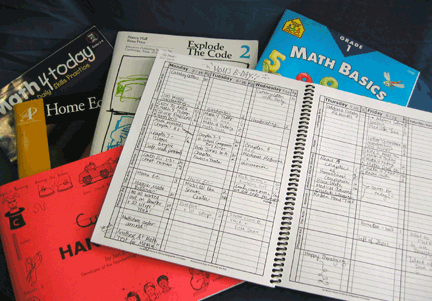
I do this in 4 week blocks. So right now, I'm only concerned with the first 4 weeks of planning. See my earlier post, on how I'm using "blocks" to help me keep my sanity!
On a blank monthly calendar, I'll put the week's goals for each subject in the left column (Sunday) and then break it down into 5 days of assignment work, metering out the work so it is roughly equalized. I gauge the number of hours available for academics and try to estimate a reasonable amount of work to be completed. I'll do this while referencing my subject areas weekly goal list,
I'll use this monthly calendar planner as my reference to give each child their daily/weekly assignment.
When goals are accomplished I'll check them off, and if they take more time than I've allotted, I'll use my trusty eraser and make adjustments as I go.
On Monday morning, each child will receive their own copy of their week's assignment, with every day filled in with the requirements for each subject. Their copy will have more details than mine so they know exactly what is expected of them. What to read, what to do, what to write and pass in for marking.
Both of my children enjoy independence, so I let them choose what order to work on their material for the most part. (With the exception of the weekly conferences I hold with them, which are scheduled on Monday morning for both, and on Wed morning for the eldest and Thursday morning for the younger.)
I always write the subjects down in the order I recommend they tackle them, but if they want to switch it up, that's fine with me. My goal is to raise engaged learners, and if they don't feel that the timing is right to engage with a particular subject and want to work on something else, I think that's just fine.
Donna Young has a great wealth of forms and charts to use. I'm sure you can find something to suit every need there!
Related posts:
- Gearing Up for Fall - Organizing the kids
- Gearing up for Fall - Our Weekly Scedule
- Gearing Up for Fall - Pacing The Subjects
Tuesday, August 28, 2012
Gearing Up for Fall - Organizing the kids
When I was a kid, I loved shopping for school supplies. I still do! My kids are happy to let me do it for them, so I will -- happily. Although a part of me wishes that they took as much glee in fresh stationery supplies as I do.
 Some basic materials we need for Fall are:
That's about it really. We've got rulers, scissors, tape, colored pencils, white boards, sheet protectors and craft supplies in our stash already so that should cover it.
Throughout the year we'll need some bristol board or special items for projects but we'll get those as we need them.
The children's 3 binders will be used as follows:
The Weekly Binder will be a 1.5 inch sturdy, flat-lying binder that they can keep all their paperwork in for current assignments. Math, Writing, Spelling, History, Science ... anything that uses handouts or writing paper.
The Storage Binder will be a 3 inch binder that is for overflow. At the end of unit or semester, completed work will be transferred into the storage binder.
The Assessment Binder will be a 1 inch "portfolio" of their year's work. Divided into subjects as the other 2 are, but only containing the assessment materials: tests, projects, reports, and samples of work selected at the end of unit or semester when the storage transfer occurs. This binder is invaluable at the end of the year when it comes time to write report cards, and file government paperwork. Everything is in one place, and accessible for me when it comes time to summarize the year's work.
My binder will contain my plans for each subject, notes on the children's struggles and successes, grade charts and other tools to keep my teacher skills finely tuned.
Related posts:

- paper
- notebooks
- pencils
- pens
- markers and
- binders: 3 per child - 1 Weekly Binder, 1 Storage Binder and 1 Assessment Binder. Plus 1 for me.
That's about it really. We've got rulers, scissors, tape, colored pencils, white boards, sheet protectors and craft supplies in our stash already so that should cover it.
Throughout the year we'll need some bristol board or special items for projects but we'll get those as we need them.
The children's 3 binders will be used as follows:
The Weekly Binder will be a 1.5 inch sturdy, flat-lying binder that they can keep all their paperwork in for current assignments. Math, Writing, Spelling, History, Science ... anything that uses handouts or writing paper.
The Storage Binder will be a 3 inch binder that is for overflow. At the end of unit or semester, completed work will be transferred into the storage binder.
The Assessment Binder will be a 1 inch "portfolio" of their year's work. Divided into subjects as the other 2 are, but only containing the assessment materials: tests, projects, reports, and samples of work selected at the end of unit or semester when the storage transfer occurs. This binder is invaluable at the end of the year when it comes time to write report cards, and file government paperwork. Everything is in one place, and accessible for me when it comes time to summarize the year's work.
My binder will contain my plans for each subject, notes on the children's struggles and successes, grade charts and other tools to keep my teacher skills finely tuned.
Related posts:
- Gearing Up for Fall - Student Assignments: Weekly/...
- Gearing up for Fall - Our Weekly Scedule
- Gearing Up for Fall - Pacing The Subjects
Sunday, August 26, 2012
Gearing Up for Fall - Pacing The Subjects

For example my 8th grader will be studying
- Geometry (Math-U-See,)
- Modern History (Story of the World,)
- English Literature I (Reading and Writing through the Classics,)
- Physics (The Great Courses: Physics and our Universe, How it all works,)
- as well as other areas of study like Art, Music, Home Economics, Health Ed, and Phys Ed.
In examining the yearly calendar I have discovered that there are 32 weeks in my formal school year (Sept 10- June 14.)
Each subject has a scope and sequence of material to be covered. By looking at the amount of material to cover I am able to dole it out evenly throughout the school year.
It ends up working out like this:
- Physics: 60 lectures in the series at 2 per week gets it done, with 2 weeks of wiggle room.
- Geometry: 30 lessons at one a week, perfect! Leaves 2 weeks for difficult chapters which might take extra practice to master.
- English Lit: I've decided on 8 units which will each take 4 weeks. 32 exactly.
- History/Geography: There are 42 units, each with 2 parts for a total of 84 items to cover. This means that we have to do History M/W/F. to get through them all - covering 3 parts or 1.5 units per week.
For each subject I write out a list of weekly goals: 32 weeks, 32 goals for each subject.
I don't put them on the calendar yet, though. I keep each subject listed separately and cross of the goals as we complete them. This prevents a lot of unnecessary erasing on the calendar, and in the children's assignment books.
Now that I have perspective, I put things into a weekly schedule similar to the kind we had in school, it has which subjects on which days.
- Social Studies - Mon/Wed/Fri 1 hour per day
- Science (Physics) - Tues/Thurs 1 hour per day
- Math -daily 1 hour per day
- Literature - daily. 1.5 hours per day - plus reading time.
- Gym - 1.5 hours per week (Saturday)
- Music - 1 hour per day (includes private lesson time)
How many hours a week does your middle-schooler spend on academics?
Related posts
- Gearing Up for Fall - Student Assignments
- Gearing Up for Fall - Organizing the kids
- Gearing up for Fall - Our Weekly Scedule
Saturday, August 25, 2012
English Literature : Excellence in Literature (gr 8-12)
We're doing something new this year for our 8th Grade Language Arts course.
Since my 8th grader is also my eldest child, that should come as no surprise -- we get to break new ground together every year.
 A dear homeschooling friend of mine used this system with her son last year. It's called Excellence in Literature, Reading and Writing Through the Classics, by Janice Campbell. And it's ideal for late logic and rhetoric stage learners.
I'm a science major, and the last English Lit course I took was English 1000, back too long ago to admit. I always liked English in school, but it has not been my forte as a home school teacher.
I have struggled over the years with finding a good structure for teaching English, and I'll admit that I haven't worried much about it. We read. A lot. And we talk about books. My son has done a couple of book reports, but after 1 or 2 of those, it feels like beating a dead horse.
We're at the point now, though, where I would like him to start doing some structured work in Essay writing and Literary Analysis. These are big words, but they are concepts that I feel are important to cover well, and to do this I'd like to get a good start on it.
Enter Excellence in Literature. Oh. My. Goodness. I can't say enough about this program. I love it. And I'm so glad I found it when I did. The timing is perfect.
AND, the best and most wonderful thing about it is that it's laid out for homeschoolers. There are specific tasks for the student and specific tasks for the "writing mentor" that's me...
The course is brilliant.
On top of all that goodness, it's under $30, lasts a whole year, can be used by multiple children and is downloadable so you can get started using it anytime you like!
If you're looking for literature studies for Junior or Senior High students I urge you to have a serious look at this program. There are 5 levels altogether, perfect for using in grades 8-12.
Related posts:
Books for Excellence in Literature
Since my 8th grader is also my eldest child, that should come as no surprise -- we get to break new ground together every year.
I'm a science major, and the last English Lit course I took was English 1000, back too long ago to admit. I always liked English in school, but it has not been my forte as a home school teacher.
I have struggled over the years with finding a good structure for teaching English, and I'll admit that I haven't worried much about it. We read. A lot. And we talk about books. My son has done a couple of book reports, but after 1 or 2 of those, it feels like beating a dead horse.
We're at the point now, though, where I would like him to start doing some structured work in Essay writing and Literary Analysis. These are big words, but they are concepts that I feel are important to cover well, and to do this I'd like to get a good start on it.
Enter Excellence in Literature. Oh. My. Goodness. I can't say enough about this program. I love it. And I'm so glad I found it when I did. The timing is perfect.
AND, the best and most wonderful thing about it is that it's laid out for homeschoolers. There are specific tasks for the student and specific tasks for the "writing mentor" that's me...
The course is brilliant.
On top of all that goodness, it's under $30, lasts a whole year, can be used by multiple children and is downloadable so you can get started using it anytime you like!
If you're looking for literature studies for Junior or Senior High students I urge you to have a serious look at this program. There are 5 levels altogether, perfect for using in grades 8-12.
Related posts:
Books for Excellence in Literature
Friday, August 24, 2012
Gearing Up for Fall - The calendar
I'm gearing up for Fall studies. This is always an exciting time for me. Planning is one of the things I enjoy the most about homeschooling. I like to organize the year, and map out our plan of attack. I like to chart and schedule and assemble the resources to make my job as smooth sailing as possible.

The first thing I do is plan the calendar.
This year, I'm trying something new. We're going to do our work in "blocks." We'll work hard for 4-6 weeks and then take a week off. This will give us 2 week -long breaks during the first semester. We'll take our Christmas break and resume a rigorous school schedule in January, again taking a week off every 4-6 weeks for the remainder of the year. I've got June 14th as our last official day of curriculum studies. This will leave us with a couple of weeks at the end of June to tie up any loose ends.
The reason I've decided to make this change is that I've often found myself becoming a slave to my schedule and losing steam after a couple of months. Although kids thrive on routine, I do not. It bores me.
I'm expecting that the weeks we take off will be a nice shake up in the monotony of the year, giving us a chance to get out for some field trips, catch up on stray bits of assignments, and do things we don't ordinarily have time to do (or things that we feel we have to "squeeze in" so we can attend to our studies.)
Beginning on Monday, I'll be posting a series of follow-up posts detailing the way I organize our subjects, our selves, and our time.
How do you structure your school year?

The first thing I do is plan the calendar.
This year, I'm trying something new. We're going to do our work in "blocks." We'll work hard for 4-6 weeks and then take a week off. This will give us 2 week -long breaks during the first semester. We'll take our Christmas break and resume a rigorous school schedule in January, again taking a week off every 4-6 weeks for the remainder of the year. I've got June 14th as our last official day of curriculum studies. This will leave us with a couple of weeks at the end of June to tie up any loose ends.
The reason I've decided to make this change is that I've often found myself becoming a slave to my schedule and losing steam after a couple of months. Although kids thrive on routine, I do not. It bores me.
I'm expecting that the weeks we take off will be a nice shake up in the monotony of the year, giving us a chance to get out for some field trips, catch up on stray bits of assignments, and do things we don't ordinarily have time to do (or things that we feel we have to "squeeze in" so we can attend to our studies.)
Beginning on Monday, I'll be posting a series of follow-up posts detailing the way I organize our subjects, our selves, and our time.
How do you structure your school year?
Thursday, March 22, 2012
Chemistry Fun!
As we prepare to begin a chemistry program I thought it would be a good idea for my boys to get a sense of what exactly the Elements are. We've had periodic tables around the house in various forms forever. But really what exactly are elements? Enter: Periodic Table Videos! At first glance this is website has just a periodic table on it, but each of the elements has a clickable link to a youtube video produced by the University of Nottingham in England.
These videos are presented by the most likeable and entertaining geeks on YouTube. We kids are a big fan of Pete...and his outakes on fun with hydrogen balloons. You really must check these out!

These videos are presented by the most likeable and entertaining geeks on YouTube. We kids are a big fan of Pete...and his outakes on fun with hydrogen balloons. You really must check these out!
We've been using these in conjunction with the Basher Book of the Periodic Table.

You'll have to click this link, for some reason the image links aren't functional on the blog.
Subscribe to:
Posts (Atom)