Wednesday, August 29, 2012

Gearing Up for Fall - Student Assignments: Weekly/Daily

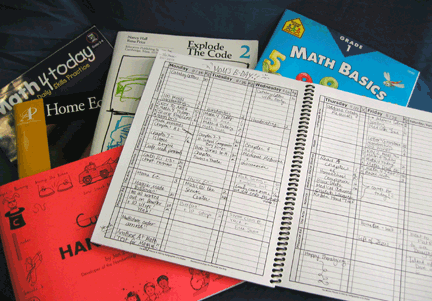
Once I have each subject organized into a series of goals, I can start to pencil in the details of my monthly teacher planner.

I do this in 4 week blocks.   So right now, I'm only concerned with the first 4 weeks of planning.  See my earlier post, on how I'm using "blocks" to help me keep my sanity!

On a blank monthly calendar, I'll put the  week's goals for each subject in the left column  (Sunday) and then break it down into 5 days of assignment work, metering out the work so it is roughly equalized.   I gauge the number of hours available for academics and try to estimate a reasonable amount of work to be completed.  I'll  do this while referencing my subject areas weekly goal list,

I'll use this monthly calendar planner as my reference to give each child their daily/weekly assignment.

When goals are accomplished I'll check them off, and if they take more time than I've allotted, I'll use my trusty eraser and make adjustments as I go.

On Monday morning, each child will receive their own copy of their week's assignment, with every day filled in with the requirements for each subject.   Their copy will have more details than mine so they know exactly what is expected of them.  What to read, what to do, what to write and pass in for marking.

Both of my children enjoy independence, so I let them choose what order to work on their material for the most part.  (With the exception of the weekly conferences I hold with them, which are scheduled on Monday morning for both, and on Wed morning for the eldest and Thursday morning for the younger.)

I always write the subjects down in the order I recommend they tackle them, but if they want to switch it up, that's fine with me.  My goal is to raise engaged learners, and if they don't feel that the timing is right to engage with a particular subject and want to work on something else, I think that's just fine.

Donna Young has a great wealth of forms and charts to use.  I'm sure you can find something to suit every need there!

Related posts:


Tuesday, August 28, 2012

Gearing Up for Fall - Organizing the kids

When I was a kid, I loved shopping for school supplies.  I still do!  My kids are happy to let me do it for them, so I will -- happily.  Although a part of me wishes that they took as much glee in fresh stationery supplies as I do.

Some basic materials we need for Fall are:


  • paper
  • notebooks
  • pencils
  • pens
  • markers and 
  • binders:  3 per child - 1 Weekly Binder, 1 Storage Binder and 1 Assessment Binder.  Plus 1 for me.


That's about it really.  We've got rulers, scissors, tape, colored pencils, white boards, sheet protectors and craft supplies in our stash already so that should cover it.

Throughout the year we'll need some bristol board or special items for projects but we'll get those as we need them.

The children's 3 binders will be used as follows:
The Weekly Binder will be a 1.5 inch sturdy, flat-lying binder that they can keep all their paperwork in for current assignments.  Math, Writing, Spelling, History, Science ... anything that uses handouts or writing paper.
The Storage Binder will be a 3 inch binder that is for overflow.  At the end of unit or semester, completed work will be transferred into the storage binder.
The Assessment Binder will be a 1 inch "portfolio" of their year's work.  Divided into subjects as the other 2 are, but only containing the assessment materials: tests, projects, reports, and samples of work selected at the end of unit or semester when the storage transfer occurs.  This binder is invaluable at the end of the year when it comes time to write report cards, and file government paperwork.  Everything is in one place, and accessible for me when it comes time to summarize the year's work.

My binder will contain my plans for each subject, notes on the children's struggles and successes, grade charts and other tools to keep my teacher skills finely tuned.

Related posts:


Monday, August 27, 2012

Gearing up for Fall - Our Weekly Scedule

Homeschooling is a dynamic experience and it's subject to change.  But, like all important things in life, it's helpful to have a plan.  Without a plan you'll do a lot of wheel-spinning, and you'll end up feeling frustrated that you didn't find the time for exciting ideas.

Our plan is simply a designated time for learning activities.

It ends up looking something like this:
The yellow areas are study time  The blue areas are weekly outings and the green is SQUIRT. Sustained Quiet Uninterrupted Independent Reading Time.  This is quiet time for everyone in the house and it's from 2pm-3pm every day.

The day starts at 8:30 after breakfast cleanup.  We break for a substantial snack at 10:30 and have lunch at 1:30.

Within this framework, I will build a plan for the specific subjects to be tackled each day.  I'll use my time estimations and goals from my past post to fill in the a rough idea of which subjects on which days.

Do you use a weekly time allocation schedule?

Related posts

Sunday, August 26, 2012

Gearing Up for Fall - Pacing The Subjects


Once the calendar dates have been established, the next thing I do is examine the goals I have for each subject area.


For example my 8th grader will be studying


In examining the yearly calendar I have discovered that there are 32 weeks in my formal school year (Sept 10- June 14.)

Each subject has a scope and sequence of material to be covered.  By looking at the amount of material to cover I am able to dole it out evenly throughout the school year.

It ends up working out like this:

  • Physics: 60 lectures in the series at 2 per week  gets it done, with 2 weeks of wiggle room.
  • Geometry: 30 lessons at one a week, perfect! Leaves 2 weeks for difficult chapters which might take extra practice to master.
  • English Lit: I've decided on 8 units which will each take 4 weeks.  32 exactly.
  • History/Geography: There are 42 units, each with 2 parts for a total of 84 items to cover.  This means that we have to do History M/W/F. to get through them all - covering 3 parts or 1.5 units per week.


For each subject I write out a list of weekly goals: 32 weeks, 32 goals for each subject.

I don't put them on the calendar yet, though. I keep each subject listed separately and cross of the goals as we complete them.  This prevents a lot of unnecessary erasing on the calendar, and in the children's assignment books.

Now that I have perspective, I  put things into a weekly schedule similar to the kind we had in school, it has which subjects on which days.

  • Social Studies - Mon/Wed/Fri  1 hour per day
  • Science (Physics) - Tues/Thurs  1 hour per day
  • Math -daily 1 hour per day 
  • Literature -  daily.   1.5 hours per day - plus reading time.
  • Gym - 1.5 hours per week (Saturday)
  • Music - 1 hour per day (includes private lesson time)
This schedule gives my 8th grader 24  hours of structured learning time per week.  That's a good foundation, on top of that he'll learn vicariously and read and experience life.  It's shaping up to be a productive year.

How many hours a week does your middle-schooler spend on academics?

Related posts


This Summer My Kids Went to Private School

That title got your attention didn't it?

My boys have been home schooled since the beginning and have never attended a formal educational institution.

But, this summer they donned private school uniforms and sat in desks with their classmates for hours on end....while working as background performers on the CBC TV series Mr. D.  If you watch, you may glimpse them  in Gerry D's Grade 5 class and Grade 9 class.


This is nothing like the work they did in the Charles Darwin mini-series where you see them performing roles. Background performers just "flesh out the scene" So even though they're there, but you might not always see them!

I'm not sure what it did for their opinion of school, but it was a great part-time job, and I haven't heard them asking me to register them in "real school" yet!


Saturday, August 25, 2012

English Literature : Excellence in Literature (gr 8-12)

We're doing something new this year for our 8th Grade Language Arts course.
Since my 8th grader is also my eldest child, that should come as no surprise -- we get to break new ground together every year.

A dear homeschooling friend of mine used this system with her son last year.  It's called Excellence in Literature, Reading and Writing Through the Classics, by Janice Campbell.  And it's ideal for late logic and rhetoric stage learners.

I'm a science major, and the last English Lit course I took was English 1000, back too long ago to admit.  I always liked English in school, but it has not been my forte as a home school teacher. 

I have struggled over the years with finding a good structure for teaching English, and I'll admit that I haven't worried much about it.  We read.  A lot.  And we talk about books.  My son has done a couple of book reports, but after 1 or 2 of those, it feels like beating a dead horse. 

We're at the point now, though, where I would like him to start doing some structured work in Essay writing and Literary Analysis.  These are big words, but they are concepts that I feel are important to cover well, and to do this I'd like to get a good start on it.

Enter Excellence in Literature.  Oh. My. Goodness.  I can't say enough about this program. I love it.  And I'm so glad I found it when I did.  The timing is perfect.

AND, the best and most wonderful thing about it is that it's laid out for homeschoolers. There are specific tasks for the student and specific tasks for the "writing mentor" that's me...
The course is brilliant.

On top of all that goodness, it's under $30, lasts a whole year, can be used by multiple children and is downloadable so you can get started using it anytime you like! 

If you're looking for literature studies for Junior or Senior High students I urge you to have a serious look at this program. There are 5 levels altogether, perfect for using in grades 8-12.

Related posts:
Books for Excellence in Literature


Friday, August 24, 2012

Gearing Up for Fall - The calendar

I'm gearing up for Fall studies.  This is always an exciting time for me.  Planning is one of the things I enjoy the most about homeschooling.  I like to organize the year, and map out our plan of attack.  I like to chart and schedule and assemble the resources to make my job as smooth sailing as possible.


The first thing I do is plan the calendar.

This year, I'm trying something new.  We're going to do our work in "blocks."  We'll work hard for 4-6 weeks and then take a week off.  This will give us 2 week -long breaks during the first semester.  We'll take our Christmas break and resume a rigorous school schedule in January, again taking a week off every 4-6 weeks for the remainder of the year.  I've got June 14th as our last official day of curriculum studies.  This will leave us with a couple of weeks at the end of June to tie up any loose ends.

The reason I've decided to make this change is that I've often found myself becoming a slave to my schedule and losing steam after a couple of months.  Although kids thrive on routine, I do not.  It bores me.

I'm expecting that the weeks we take off will be a nice shake up in the monotony of the year, giving us a chance to get out for some field trips, catch up on stray bits of assignments, and do things we don't ordinarily have time to do (or things that we feel we have to "squeeze in" so we can attend to our studies.)

Beginning on Monday, I'll be posting  a series of follow-up posts detailing the way I organize our subjects, our selves, and our time.

How do you structure your school year?


Wednesday, June 13, 2012

Summer....it is time to take a break? or time to delve further?

Many of us who attended public school as children have fond memories of languishing summers free of teachers, schedules and homework.  Today my homeschooling family also has fond summer memories of bike riding, camping, fun at the beach and lazy rainy days spent reading books.


Does this mean that we don't continue our studies through the summer?  It does not.

For us, summer is a time when the rest of our obligations disappear.  No more trips to the violin teacher, no more swimming lessons, no more karate class, no more hustle and bustle.  Our days are our own to carve in whatever way we choose.

Because we love to learn and are creative people this means that we enjoy continuing to pursue learning through the summer.  And without the need to drop things and drive to "lessons" it means that we can truly take things at our own pace, reading for hours or getting really messy with some kind of science or kitchen project.

I also like the kids to get a daily dose of math and writing.   We do this in a relaxed manner and not every single day through the summer.  There are weeks that we do no structured curriculum studies at all because we've chosen to go on vacation or take a little break.  And there are weeks that we get so fired up about something new that we dedicate 30 hours that week to it. But to be honest, this is no different than the regular school year when we allow our life to be flexible -- and thank homeschooling for our ability to do so.

How do you spend your homeschooling summer?  Do you like to continue studies through the summer months?  Are you happy to take a few months off?  We'd love to hear your ideas and experiences.