Wednesday, March 27, 2013

MLA format for Citing Reference Works

This is a great guide to citing your references using MLA format:
Finger Pecking

MLA format is a scholarly publication format first used by Modern Language Association of America.  This is why it is called MLA format.  It gives guidelines for properly formatting a paper including citation of works used for research or discussed in the paper.

It is the standard used my most universities  and by most academic publications.


Tuesday, March 26, 2013

Building and Writing an Essay

Getting organized to build an essay can be a daunting task.
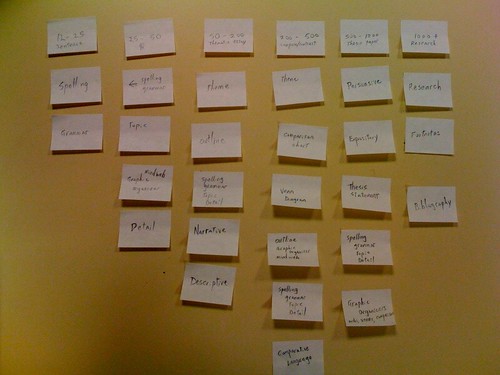
For me, the best way to do it is to write all of my concepts on post-it notes and then lay them out in the order I would like to discuss them.


Writing framework
This takes the clutter out of my brain and allows me to work it around until it is organized.
Laying the post-its out on a white board is helpful since you can use your marker to add notes or arrows to help your essay flow.

It's also a great way to find holes or see where you've got overlapping or extra material.

Writing your first draft becomes effortless, just grab the first post-it and write.  Then move on to the second one!  Repeat until you get to the final one.

If you've got a word count target, this is also a great way to determine before you begin if you've got enough content to work with.  If you can write 100 words about 10 ideas, you've got a 1000 word essay, and slightly more with an introductory and summarizing paragraph!


Monday, March 25, 2013

Literary Approach Paper Format

Another key paper used in Excellence in Literature is the Literary Approach Paper.  If you're looking for a framework and example of this type of paper, here's a source for reference.


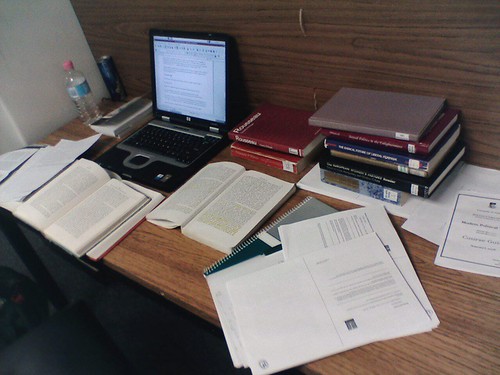
Essay Time (Rousseau and Women): My desk at the library


Saturday, March 23, 2013

Historical Approach Paper Format Framework


If your students are with Excellence In Literature this year, you might find this framework for historical approach paper helpful. 

Thursday, January 24, 2013

Multiplication Online Drill

Just a quick note today to mention a super effective online drill for math facts. My 9-year old is using it for multiplication these days. It's one of the Math-U-See online resources.

It's super easy to use and can be calibrated to drill only the required facts, or do the whole shabang!
Each drill does 20 questions, and times the student.  I have my 9-year old do the drill 5 times before he starts his math for the day.  He records his score and time.  

Monday, September 17, 2012

Multiplication Fun

There's nothing like a little fun inserted into your school day.  I have found that without question, anything that requires drill and retention is easily and best accomplished in a game setting.

My boys enjoy using the computer for their school work when they get the opportunity, and for my 4th Grader, Timez Attack is just the answer!


There are "skins" available to change the game setting, and they do add some special fun to the game.  The free version uses a dungeon setting and that might be just fine for your student.

Personally, I recommend the "Rental" of the Standard game, unless you have younger children that you plan to use it with, in which case go for the "Buy" version so you can use it forever.

It's $25 for the year to rent the standard edition, but after a year, your child will be a whiz at Math facts!  You can also use it for more than one child concurrently.  We tried the free version, but one thing for sure, kids love variety and so for me, it was well worth the cost for the extra levels.   And, the Retention feature is more fully developed in the rental version, from a teaching perspective, that's always a bonus.

Mulitplication Math Game Elementary School

This game is highly entertaining, and in our house you can frequently find another child watching over the shoulder of the student who is playing.  This has the side benefit of having older children refresh their facts or giving younger children a "leg up" on math facts for when their turn comes!

Saturday, September 15, 2012

Friday, September 14, 2012

So you want to write the next Hunger Games? Elements of Fiction Writing

Have you ever started to write a story that you couldn't seem to finish?  Have you had a great idea for a story, know how it was going to start and end but ran out of steam just before writing the middle?

Maybe it's because you were writing from the seat of your pants; believing that you have the ability to write a good story because you love to read and you've read so many good stories.


It's possible to write a very good story on instinct alone. But it might be the case that you need a little help to really craft a compelling and satisfying story for your reader.

Let's take a minute and think about some of the elements that make a story compelling, and see where you might have gone astray.

A work of fiction has Characters, Theme, Setting, Plot, Conflict, and Voice.

All of these areas require careful attention in order to create a cohesive story that creates a new reality for the reader -- no matter how fantastic the characters and events may be.

Today, let's examine the Voice of your story.  

To understand voice, do the following:


Want to try?  I'm going to flip to a random page in each of these books and quote a small section with the names all changed.  I'm going to use Sesame Street character names and use He for all of the pronouns.

Example 1:

'I think you should still follow that plan,' said Grover, 'I do not think the road will prove too hard for your courage.   But if you require clearer counsel, you should ask Oscar.  I do not know the reason for your flight and therefore I do not know by what means your pursuers will assail you.  These things Oscar must know.  I suppose you will see him before you leave..." 

Example 2:

I whip around. It's come from the left, so I can't pick it up very well. And the voice was hoarse and weak. Still, it must have been Ernie. My eyes peruse the bank, but there is nothing. Just mud, the plants the base of the rocks.

Example 3:

All the same, it wasn't what you'd call the perfect end to the day Kermit thought, as he lay awake much later listening to Fozzy and Beaker falling asleep.  There was a very good chance they were going to get caught by Miss Piggy or Animal,and yet Kermit felt he was pushing his luck.  The Count's face kept looming up out of the darkness -  this was his big chance to beat Big Bird face to face.  He wasn't going to miss it.  

Have you got your guesses ready?

I'll give you the answer.


The first example was from The Fellowship of The Ring, the last example was from Harry Potter and the middle one was from The Hunger Games.

I'm going to bet you got all 3 of them right (if you've read the books.)

The reason you could tell which was which was because of the writers Voice.  It's not what the author is saying but how she says it.  The way she puts words together. The detail. The imagery. Even the attitude or the personality of the story itself.  All of this together is the Voice, and it helps the reader identify with a story in the same way we identify with a good friend.